Can A Will Be Witnessed Online? The Ontario Court Will Decide

In order for a typed will to be valid, Ontario’s legislation is clear that all formalities must be met, including that the testator: 1) makes or acknowledges the signature in the presence of two or more attesting witnesses present at the same time; and 2) two or more of the attesting witnesses subscribe the will in the presence of the testator.

When the will goes through the probate process, which is necessary for most estates, there will be many issues if the formal requirements set out in the Succession Law Reform Act are not met.

In the case of an 80-year old couple faced with the mandatory quarantine caused by COVID-19, the court has agreed to make a decision on an urgent basis as to whether the witnessing of a will by way of video conference meets the formalities of a will.


The formalities of a will may seem out of date given that our technology has long allowed for video conferencing. However, it is important to understand that the reason for the formal requirements is to allow the testators some protection whereas the witnesses, by way of physical presence in the same room as the testator, can help prevent situations of undue duress or incapacity. For this reason, as long as the formalities of a will are met, the will is presumed to be valid.

The witnesses cannot be beneficiaries or a spouse of the beneficiaries and, therefore, this means that the formalities may affect not just elderly people but also those that cannot meet with witnesses.

The Superior Court of Justice will decide on this issue within the week. 

*The above is drafted by Soica Law Professional Corporation and not intended as legal advice.

Wills: Children, Marriage, Divorce

Those that already have wills or are looking to obtain one should understand the impact of their family law situation on the validity of the will.

  1. Children

Section 61 of the Children’s Law Reform Act allows for testamentary custody, meaning that a person entitled to custody may appoint by will one or more persons to have custody of the children and to be a guardian of property of the children. This appointment expires automatically within ninety days or, if the appointee applies for custody or guardianship of the property of the children within those ninety days, then the appointment expires when the application is disposed of.

2. Marriage

The will is revoked by marriage of the testator except if: i) there is a declaration in the will that it is made in contemplation of the marriage. In doing so, the will must very clearly state the marriage and name of the future betrothed; ii) the spouse of the testator elects to take under the will, by an instrument in writing signed by the spouse and filed within one year after the testator’s death in the office of the Estate Registrar for Ontario; and iii) the will is made in exercise of a power of appointment of property which would not in default of the appointment pass to the heir, executor or administrator of the testator or to the persons entitled to the estate of the testator if he or she died intestate.

3. Divorce

Although a will is not automatically revoked by a judgment absolute of divorce, any provisions in the will regarding the former spouse will be nullified, including a devise of bequest of a beneficial interest in property to the former spouse, an appointment of the former spouse as executor or trustee, and the conferring of a general or special power of appointment on the former spouse.  

4. Election of surviving spouse

Spouses should also be aware that the surviving spouse has the right to choose between electing to go under the will, intestacy, or section 6 of the Family Law Act (deeming the spouses to be separated), and/or the appropriate combination thereof if the will so provides. This election must be made within six months, otherwise the surviving spouse is deemed to have elected to take under the will or the Succession Law Reform Act, as the case may be, unless the court orders otherwise. The provisions contained in section 6 of the Family Law Act detail the surviving spouse’s different choices with regard to election:

Spouse’s will

(1) When a spouse dies leaving a will, the surviving spouse shall elect to take under the will or to receive the entitlement under section 5.  R.S.O. 1990, c. F.3, s. 6 (1).

Spouse’s intestacy

(2) When a spouse dies intestate, the surviving spouse shall elect to receive the entitlement under Part II of the Succession Law Reform Act or to receive the entitlement under section 5.  R.S.O. 1990, c. F.3, s. 6 (2).

Spouse’s partial intestacy

(3) When a spouse dies testate as to some property and intestate as to other property, the surviving spouse shall elect to take under the will and to receive the entitlement under Part II of the Succession Law Reform Act, or to receive the entitlement under section 5.  R.S.O. 1990, c. F.3, s. 6 (3).

Property outside estate

(4) A surviving spouse who elects to take under the will or to receive the entitlement under Part II of the Succession Law Reform Act, or both in the case of a partial intestacy, shall also receive the other property to which he or she is entitled because of the first spouse’s death.  R.S.O. 1990, c. F.3, s. 6 (4).

Gifts by will

(5) The surviving spouse shall receive the gifts made to him or her in the deceased spouse’s will in addition to the entitlement under section 5 if the will expressly provides for that result.  R.S.O. 1990, c. F.3, s. 6 (5).

How To Make Your Own Free Will During Covid-19

While regular wills are drafted by lawyers and they require formalities such as witnesses, proper language, and affidavit of execution, there is another option for Ontario: handwritten wills (the proper terminology in accordance with the Succession Law Reform Act is holograph will). We hope that the following instructions are useful and, should you have any questions, you may book a phone consultation to obtain legal advice or you may have a new formal and proper will, once it becomes safe to do so.

In order for the holograph will to be valid, it should:

  1. Be entirely handwritten by the testator;
  2. Signed by the testator;
  3. There should be proof of the handwriting of the testator and, in today’s technology, making a video of the writing of the will would be well advised.

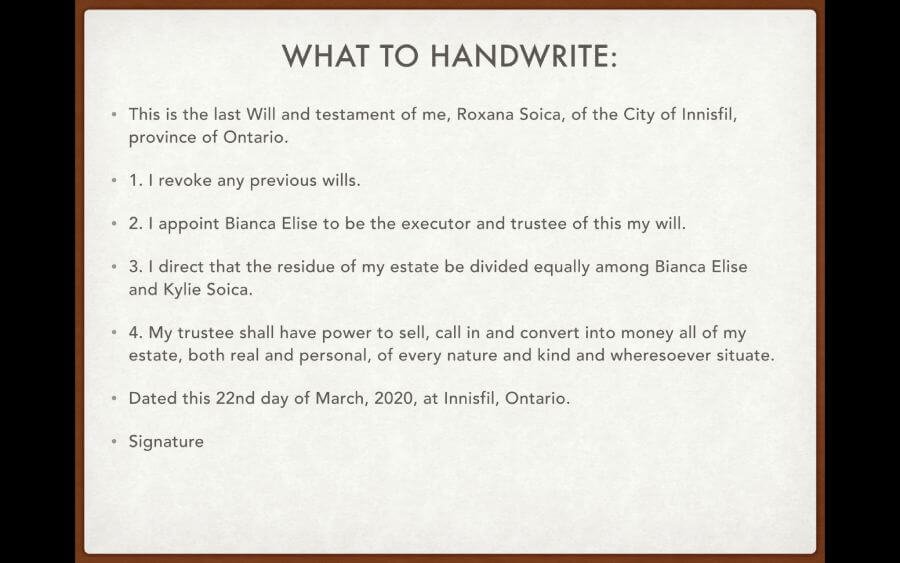
The following is an example with the minimum necessary provisions:

This is the last Will and testament of me, Roxana Soica, of the City of Innisfil, province of Ontario.

1. I revoke any previous wills.

2. I appoint Bianca Elise to be the executor and trustee of this my will. 

3. I direct that the residue of my estate be divided equally among Bianca Elise and Kylie Soica.

4. My trustee shall have power to sell, call in and convert into money all of my estate, both real and personal, of every nature and kind and wheresoever situate.

Dated this 22nd day of March, 2020, at Innisfil, Ontario.

Signature

**The above is prepared by Soica Law Professional Corporation and is not intended as legal advice.

Can You Reduce The Other Parent’s Access To Your Child Because Of Covid-19?

It is remarkable that we already have a number of reported decisions with respect to the same. One such decision is Le v Norris, whereas the court determined that the COVID-19 crisis is not “an excuse for non-compliance with a child custody and access order.” The court went on to determine that the police should enforce the access order, recognizing equally the importance of following the COVID-19 guidelines:

“Physical distancing measures must be respected.  The parties must do whatever they can to ensure that neither of them nor the child, C., contracts COVID-19.  Every precautionary measure recommended by governments and health authorities in Ontario and Canada must be taken by both parties and, with their help, by C.  Neither party shall do anything that will expose him/herself or C. to an increased risk of contracting the virus.”

Similarly, in Ribeiro v Wright (decided by Mr. Justice Pazaratz), the Court was clear to indicate that the mere existence of COVID-19 will not automatically result in suspension of in-person parenting time and raising COVID-19 considerations will also not necessarily result in an urgent hearing.

Every family law litigant should follow the decision of Mr. Justice Pazaratz, who is well known among the family law community for his truism, plain language, and candour:

Every member of this community is struggling with similar, overwhelming COVID-19 multiple times each day.  

a.     The disruption of our lives is anxiety producing for everyone.  

b.    It is even more confusing for children who may have a difficult time understanding.  

c.     In scary times, children need all of the adults in their lives to behave in a cooperative, responsible and mature manner.  

d.    Vulnerable children need reassurance that everything is going to be ok.  It’s up to the adults to provide that reassurance.

e.     Right now, families need more cooperation.  And less litigation.

*The above is written by Soica Law Professional Corporation and not intended as legal advice.

Why Should You Have A Power Of Attorney For Property?

A Power of Attorney is utilized by a person (the “grantor”) to appoint (the “attorney”) to manage the grantor’s property. The attorney can do anything in respect of the property, with the following exceptions:

  • Cannot make a will for the grantor
  • Must make decisions with reasonable care
  • Must not act in conflict with the grantor’s interest
  • Must not make secret profits
  • Must not make decisions conflicting with the will of the grantor, unless expressed in the Power of Attorney document

Evidently, the grantor can limit the scope of authority granted to the attorney by expressly providing this in the Power of Attorney document. The grantor can restrict the type of property or the timing of the attorney’s authority taking effect. For example, the grantor can specify that the Power of Attorney becomes effective only when the grantor becomes mentally incapable.

There are two situations in which to have a Power of Attorney:

  1. The grantor is incapable to manage property (Power of Attorney for Property)
  2. The grantor is unavailable to make decisions (e.g. out of the jurisdiction)

Where there is no Power of Attorney, it is much more difficult and expensive to have a substitute decision-maker. There is also unpredictability regarding the person who will ultimately make all property decisions. Furthermore, it is of utmost importance to have a properly drafted Power of Attorney: the grantor requires legal advice to ensure the document meets its intended purpose; the attorney requires legal advice to ensure he/she meets all legal obligations inclusive of proper care, accounting responsibilities, fiduciary duties, and limit of decision- making. Finally, the Substitute Decisions Act, 1992 governs substitute decision-making and, in the absence of a Power of Attorney, the default provisions may not reflect the desires of the grantor.

**The content on this website is not legal advice.

Why should you and your family members have a Will?

Roughly 65% of Canadians do not have a will. Often times, clients mistakenly assume that assets automatically transfer to their loved ones or, worse, they assume the right to assets where there is no will. Dying without a will, or intestate, simply means that the division of assets is left up to the Government. Consequently, potential beneficiaries have no say in the rules of division and, in fact, the deceased also has no say in the rules of division.

The expectations of the spouse, relatives, friends, and the deceased are irrelevant where there is no will, notwithstanding specific exceptions such as joint tenancy.

The government, through the Succession Law Reform Act, dictates that the following groups may take assets:

  1. Spouse. The definition of spouse does not include common-law relationships and/or cohabitation. It mostly refers to those that are legally married.
  2. Issue. This means all lineal descendants such as children, great children, etc.
  3. Lineal ascendants and collaterals.

Although your loved ones are included in the rules of division, matters are further complicated when it comes to the share taken by each group, family law implications for spouses, and much more.

Consider this:

  • If you are a son/daughter, not having a will most likely results in your parents not receiving any assets.
  • If you have relatives that you do not wish to provide for, not having a will may achieve the opposite or make it more difficult and expensive for your intended beneficiaries to obtain assets.
  • If you have a spouse to whom you are legally married, not having a will gives the spouse solely the choice of receiving the same assets she would if you were divorced. The law is intrinsically unanticipated by most Canadians when it comes to spouses.
  • If you are in a relationship and are not legally married, not having a will may put your spouse in a vicarious position and complicate the process by which both your spouse and minor children receive assets.
  • If you are a spouse, child, or relative and know that your loved one wants you to be a beneficiary, not having a will may most likely result in you not receiving anything or a much lesser share, as well as increase expenses.
  • If you are a parent concerned with potential family law claims that a child’s spouse may have on what you leave behind, not having a will means that you do not have a say in the future of your assets
  • If you have many assets, not knowing the distinction between a will and alternatives to a will may severely increase taxes.

Now, also consider the situation where you assume that a jointly-held account with your child will automatically belong to your child. This is not so simple. There are certain factors that the court will look at to determine whether a gratuitous transfer between a parent and an adult child should be considered as a resulting trust, meaning that the child must return the account to the estate. To reduce probate taxes and ensure that your child benefits as you like, a will is an essential step in fulfilling your intention.

Another wrong assumption among Canadians is that having a will won’t make a difference. Canadians with few family members believe that they do not require a will because everything is transferred to their spouse and children as per their desires. However, the rules of division are not desire-based and have other severe implications for you and your family.

So then….when should you consider having a will? If you have any assets, you should consider having a will.

**The content on this website is not legal advice.